
Choosing the Right Legal Structure for Your Texas Medical Practice: PA vs. PLLC
Starting or restructuring a medical practice is a defining milestone for any physician. However, in Texas, selecting a business structure involves far more than basic tax planning or standard liability protection—it is a critical regulatory compliance step governed by Texas statutory law and enforced by the Texas Medical Board (TMB).
Unlike standard business owners who can form a general LLC or corporation, Texas physicians face strict statutory restrictions on the types of business entities they can form. In practice, Texas physicians are generally limited to choosing between two structures: the Professional Association (PA) and the Professional Limited Liability Company (PLLC).
The Legal Framework
Before comparing entity forms, physician-owners must understand the legal doctrines applicable to medical practices in Texas.
1. The Corporate Practice of Medicine (CPOM) Doctrine
Codified under the Texas Medical Practice Act, the CPOM doctrine strictly prohibits non-physicians or non-physician-controlled business entities from owning a medical practice or exercising control over a physician’s clinical decision-making.
In practice, this doctrine creates restrictions on the ownership of medical practices and fee-splitting arrangements:
Strict Ownership Restrictions: Only Texas-licensed physicians can hold equity, serve as governing members, or act as officers in an entity providing medical care.
Fee-Splitting Bans: Texas law strictly prohibits sharing professional medical fees with non-physicians or unregistered business entities.
The policy driving CPOM is clear: patient care must be guided exclusively by uninhibited professional medical judgment, not by commercial interests or corporate bottom lines.
2. Professional Service Organizations Under Texas Law
In addition to the CPOM doctrine, the Texas Business Organizations Code (TBOC) establishes a distinct regulatory structure for professional service organizations (referred to as "professional entities" in the statute).
Professional service organizations are legally recognized entities formed specifically to render services that require state licensure. To operate as a compliant professional entity rendering medical services, the entity must meet the following requirements:
Restricted Ownership: 100% of the entity's equity or membership interests and 100% of its managerial authority must be held by licensed professionals authorized to render medical care in Texas (with narrow statutory exceptions allowing joint ownership with specific healthcare licensees, such as Physician Assistants).
Direct Supervision: The organization may only render medical services through licensed owners, managerial officials, employees, or authorized agents.
3. The Entity Choice Available to Physicians: PA vs. PLLC
Because of CPOM and professional entity laws, physicians cannot operate a practice through a general for-profit corporation or a standard LLC. Additionally, while standard Professional Corporations (PCs) are frequently used by medical practices in other states (like California or New York), Texas law explicitly bars doctors from forming PCs for medical practice.
Therefore, in Texas, the choice is strictly restricted to a PA or a PLLC. While both entities satisfy Texas statutory requirements for practicing medicine, the entities differ significantly in governance, state maintenance, and administrative cost.
Professional Associations: The PA is a specialized Texas entity form created historically for licensed professionals like physicians. Governed by Chapter 302 of the Texas Business Organizations Code, a PA operates like a traditional corporation. It requires a formal Board of Directors, executive officers (President, Secretary, etc.), formal bylaws, and annual corporate recordkeeping. Additionally, PAs require periodic filings with the Texas Secretary of State and carry a higher initial state filing fee ($750 vs. $300 for a PLLC).
Professional Limited Liability Companies: The PLLC is the most common entity structure for modern Texas medical practices. It combines limited liability protection with flexible management. The practice’s governing provisions are outlined in a Company Agreement (or Operating Agreement), which can outline management authority (e.g., whether the entity is member-managed or manager-managed) and provisions on decision-making and voting rights. Compared with a PA, a PLLC has less formal requirements; for example, a PLLC is not required to hold annual meetings or elect officers, though a practice can choose to adopt those formalities if desired.
Key Decision Factors for Physician-Owners
When deciding between a PA and a PLLC, physician-owners should evaluate three core practical considerations:
1. Liability Protection
Both PAs and PLLCs create a robust legal shield between personal assets (homes, personal accounts) and general business liabilities (commercial office lease obligations, vendor contracts, employee disputes). Both entities protect individual owners from personal financial liability caused by the clinical malpractice of a partner or co-owner.
However, it bears emphasizing, because it is widely misunderstood: neither a PA nor a PLLC shields a physician from liability for their own professional negligence. These entities protect owners from many of the practice's general business liabilities, and often from liability for another owner's malpractice, but a physician remains responsible for their own clinical conduct. Malpractice risk must be addressed separately, primarily through insurance, compliance, and sound clinical and supervisory practices.
2. Governance and Administrative Requirements
The governance and management of your practice is where the contrast between a PA and a PLLC becomes most apparent. How decisions are made, who holds management power, and how votes are cast differ dramatically between these two entities.
Administrative Formalities:
PA: Subject to a litany of corporate requirements: electing a Board of Directors, appointing officers, holding annual director and member meetings, and keeping formal written minutes. A failure to maintain these corporate formalities can expose physician-owners to claims that the corporate veil should be pierced in litigation.
PLLC: Unless required by your own Company Agreement, not statutorily required to hold formal annual meetings, maintain official meeting minutes, or elect a board of directors. Daily operational decisions can be ratified through informal written consents (such as email acknowledgments or signed resolutions).
Management Structure:
PA: Must maintain a formal statutory hierarchy. Only a member of the PA’s governing board is eligible to serve as President. This mandatory separation between owners, governors or directors, and officers can create unnecessary bureaucratic friction for small practices.
PLLC: Can be structured as either Member-Managed (where all physician-owners directly run the daily operations of the clinic) or Manager-Managed (where daily operational authority is delegated to a designated Managing Physician or executive committee). The operating rules are fully customizable within the practice’s Company Agreement.
Voting Rights and Special Business Arrangements:
PA: Voting rights are typically standardized, and it can be difficult to establish custom voting procedures.
PLLC: Voting mechanics can be fully customized. For example, voting power can be tied to equity ownership, be made on a one-person, one-vote basis, or be tied to production metrics. The Company Agreement can also specify which equity classes have voting rights at all and define decisions that require a supermajority vote.
3. US Income Tax Classification
From an IRS perspective, neither “PA” nor “PLLC” is a distinct tax classification. Both entities offer some tax flexibility.
Under the IRS tax classification rules, a PA is automatically treated as a C corporation for tax purposes. Income of the PA is subject to double-taxation: first, at the PA-level when reported annually on IRS Form 1120, and then again when distributions are made to owners.
On the other hand, a PLLC’s default treatment is a pass-through entity. If the PLLC has one owner (i.e., a single-member PLLC), the PLLC is disregarded for tax purposes (a disregarded entity). If the PLLC has more than one owner (i.e., a multi-member PLLC), the PLLC is treated as a partnership for tax purposes. In either case, the income and losses of the PLLC flow directly to the individual tax returns of the owner(s), avoiding tax at the PLLC-level.
Qualifying PAs and PLLCs can elect to be treated as an S corporation. S corporations are pass-through entities (avoiding the double taxation for a PA), and also allow physician-owners to split the practice’s earnings into a "reasonable salary" (which is subject to self-employment tax) and owner distributions (which are not subject to self-employment tax), often generating substantial tax savings for the owners.
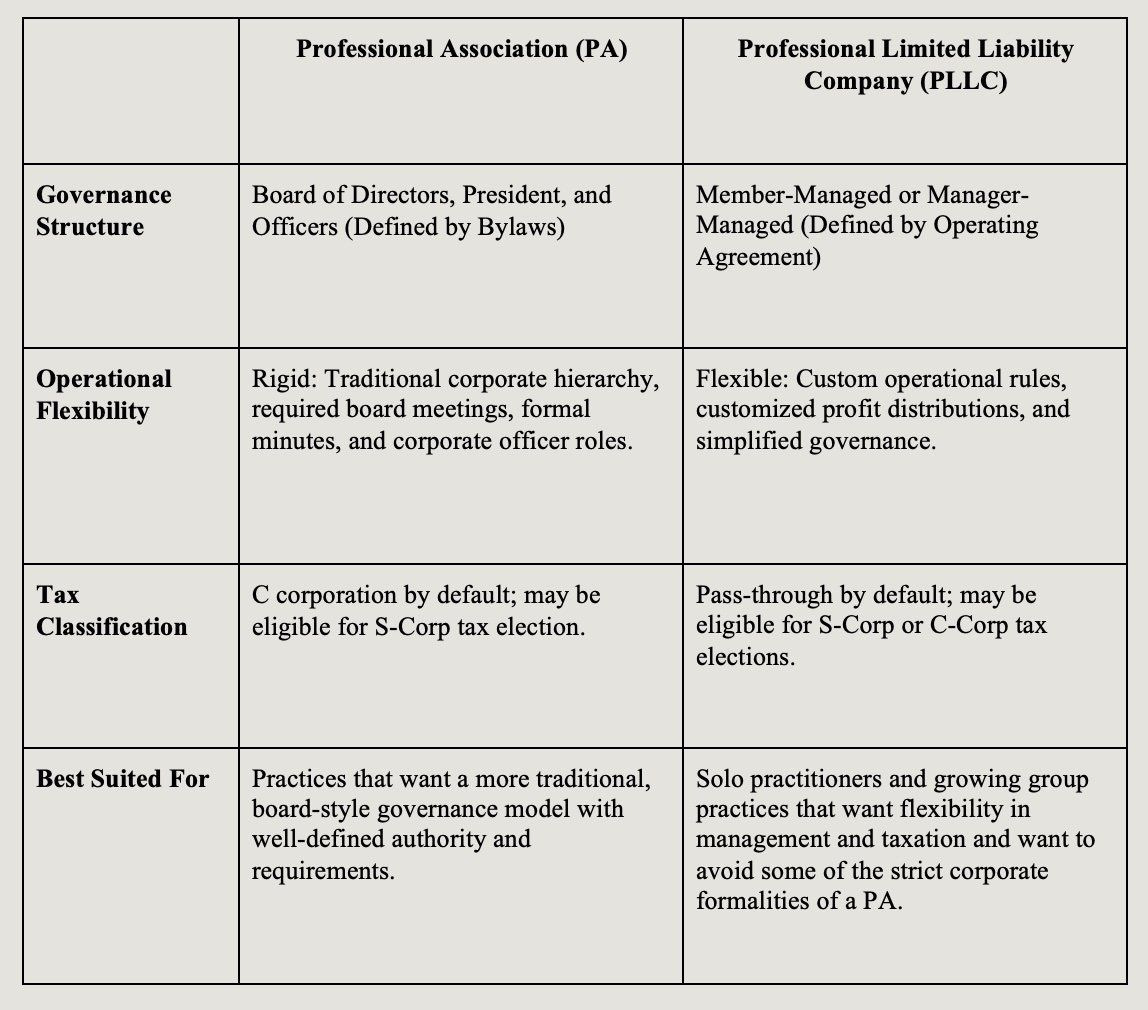
If you prefer minimal administrative paperwork, the PLLC is generally the superior choice. PAs require strict adherence to corporate formalities—including annual director meetings, official meeting minutes, formal officer appointments, and periodic Secretary of State reports. Failure to maintain these formalities in a PA can risk "piercing the corporate veil" during litigation.
Additional Considerations: Admitting New Physicians or Non-Physician Partners
1. Multi-Owner Buy-Ins and Buy-Outs
For group practices with multiple physician-owners, governance documents (PA Bylaws or PLLC Company Agreements) must address specific contingencies unique to medicine:
License Revocation or Suspension: Mandating the automatic redemption/buyback of a physician's equity if their Texas medical license is suspended or revoked by the TMB.
Equity Valuation: Establishing clear, predetermined formulas for evaluating practice equity when a partner retires, dies, or departs.
Vesting Schedules: Implementing structured vesting timelines for newly admitted physician-partners.
2. Partnering with Non-Physicians: The MSO Model
Under the CPOM doctrine, non-physicians (such as administrative executives, venture capital investors, or non-physician family members) cannot hold equity in a Texas PA or PLLC that provides medical services. To comply with this restriction, practices have begun utilizing a Management Services Organization (MSO) structure to partner with non-physicians:
The Clinical Practice (PA or PLLC): 100% owned by Texas-licensed physicians. It handles patient care, maintains medical records, employs clinical staff, and bills payors.
The MSO (Standard LLC): 100% owned by non-physician investors or executives. It handles non-clinical administrative functions, including facility leasing, equipment procurement, marketing, IT support, and billing services.
The Management Services Agreement (MSA): A detailed contract connecting the Practice and the MSO. To comply with CPOM laws and federal/state Anti-Kickback statutes, the administrative fee paid to the MSO must reflect flat, fair-market value (FMV) for services rendered rather than a percentage of medical revenues.
Strategic Next Steps for Practice Owners
Choosing between a PA or a PLLC is not merely a box-checking exercise—it sets the legal foundation for your practice’s tax strategy, asset protection, and operational growth. While the PLLC has become the standard choice for modern medical practices due to its flexibility and lower state fees, a PA may still fit established group practices accustomed to traditional corporate hierarchies.
Avoid relying on generic, off-the-shelf online templates. Generic operating agreements often fail to account for mandatory TMB ownership restrictions, statutory equity redemption rules, or CPOM compliance.
Our attorneys assist physicians across Texas in drafting custom governance agreements, structuring MSOs, and maintaining full regulatory compliance.
Ready to start? Click here to schedule a consultation with Kalaria Law today to launch, expand, or restructure your medical practice.
Disclaimer: This article is for general informational purposes only and does not constitute formal legal advice.
