
Navigating Healthcare Compliance: Stark Law and Anti-Kickback Statutes for Texas Physicians
If you own or invest in a medical practice, surgery center, lab, or imaging center in Texas, two federal laws sit quietly in the background of nearly every financial arrangement you make: Stark Law and the Anti-Kickback Statute (AKS).
While healthcare providers often mention them together, they are distinctly different legal frameworks. An arrangement that passes under one law can still trigger massive liability under the other.
Federal Framework: How Stark Law & AKS Differ
Understanding the scope of each statute is critical for ongoing compliance:
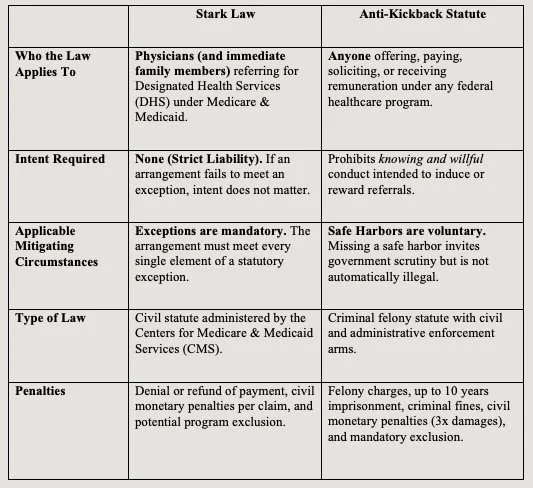
Stark Law applies strictly to physicians (or their immediate family members) who have a financial relationship with an entity and refer Medicare or Medicaid patients to that entity for Designated Health Services (DHS), such as clinical lab work, physical therapy, imaging, or hospital services. Because it is a civil, strict-liability law, any non-compliant referral triggers a violation regardless of intent. To be protected, an arrangement must satisfy every single element of a mandatory statutory exception (e.g., bona fide employment, fair-market-value space/equipment rentals, or in-office ancillary services).
Anti-Kickback Statute is a broad criminal statute that applies to anyone who knowingly and willfully offers, pays, solicits, or receives remuneration (anything of value) to induce or reward referrals for items or services payable by any federal healthcare program. Unlike Stark, compliance protection under AKS is handled through safe harbors (such as specific personal services contracts or small-investor venture structures). Falling outside an AKS safe harbor does not automatically make an arrangement illegal, but it leaves the arrangement open to scrutiny regarding intent.
The following chart summarizes the distinction between these two laws:
The Texas Layer: Commercial Payors & State Licensing
Federal regulations only apply when federal dollars (Medicare/Medicaid) are involved. Texas law, however, closes that gap by regulating commercial insurance and cash-pay patients:
Texas Patient Solicitation Act (Texas Occupations Code Chapter 102): Often termed the “Texas Anti-Kickback Statute,” this law prohibits paying or receiving remuneration to induce patient referrals across all payors, including private commercial insurance.
Texas Medical Board (TMB) Enforcement: Independent of criminal prosecution, the TMB enforces strict prohibitions against fee-splitting and illegal remuneration. Violations can jeopardize a physician's license to practice in Texas.
Why One Deal Can Trigger Both Laws
Stark Law and AKS do not operate in isolation; they stack. Consider a practice where a physician-landlord leases office space to a diagnostic imaging group:
Analysis under Stark Law: The lease creates an automatic “financial relationship” between the physician and the imaging group. To avoid a violation, the lease must satisfy every element of the Space Rental Exception under 42 C.F.R. § 411.357(a), which includes, among other requirements, a signed writing, a term of at least 1 year, set space specifications, and fair market value (FMV) rent.
The Payment Impact: If the lease fails to meet the exception (e.g., rent drops below FMV or an agreement expires), all subsequent referrals from the physician to that imaging group for Medicare or Medicaid beneficiaries become illegal. The imaging facility is prohibited from billing CMS, and Medicare/Medicaid will demand full repayment of all claims generated during the non-compliant period.
Analysis under AKS: Federal investigators look at the underlying intent. If below-market rent was offered to induce the doctor to steer Medicare or Medicaid patients to the facility, the lease constitutes illegal remuneration.
The Payment Impact: Beyond criminal felony charges, the federal government can seek civil monetary penalties and 3x the total value of the improper remuneration. Additionally, both the physician and the imaging center face mandatory or permissive exclusion from billing Medicare, Medicaid, TRICARE, or any other federal program going forward, effectively shutting down their ability to treat federally insured patients.
Under the federal False Claims Act, any Medicare or Medicaid claim submitted as a result of an AKS or Stark violation is legally considered a “false claim,” subjecting the practice to massive per-claim fines and mandatory treble damages. Once a practice identifies that a lease defect caused improper billing, the 60-Day Overpayment Refund Rule forces the provider to quantify, report, and return all affected Medicare and Medicaid funds within 60 days, or face separate, independent fraud liability.
Practical Checklist for Texas Healthcare Business Owners
Ensure Compliance with Stark Exceptions: Because Stark is a strict liability statute, good faith is not a defense. Ensure every element of an exception is documented in writing.
Maintain Fair Market Value (FMV): Medical directorships, consulting deals, and space leases must reflect true fair market value, completely independent of referral volume.
Account for Private Insurance: When structuring marketing deals or referral networks, evaluate them under Texas state law, even if no Medicare patients are involved.
Ready to start? Click here to schedule a consultation with Kalaria Law today to protect your practice from hidden regulatory and financial liabilities.
Disclaimer: This article is for general informational purposes only and does not constitute formal legal advice.
