
Letters of Intent and Term Sheets: What’s Actually Binding Under Texas Law?
Letters of intent (LOIs) and term sheets play a key role in confirming that parties are aligned on the big picture and key business terms of a deal before diving into diligence and drafting documents. A common misconception businesses have is that these documents are just a mere formality and are never binding on the parties.
In reality, when drafted carelessly, these documents can easily create unexpected legal obligations or leave critical rights completely unprotected. An ambiguous phrase or inconsistent clause can quickly turn a preliminary step into the center of a costly dispute. Understanding the fine line between an expression of intent and a binding commitment is critical to avoiding the legal traps that can derail an otherwise promising transaction.
What They Are (and How They Differ)
Although they serve the same purpose in substance, these documents differ primarily in layout and application depending on the industry and transaction type:
Letters of Intent: Typically written in a narrative letter format, an LOI outlines the basic terms of a proposed transaction. They are standard in M&A deals, commercial real estate transactions, and joint ventures.
Term Sheets: These serve the exact same general purpose but are presented in bullet points or tables rather than a narrative letter. Term sheets are the go-to format for venture capital financings, bank lending, and licensing arrangements.
How Texas Courts Look at Them
From a legal standpoint, Texas courts generally apply ordinary contract-law principles to both LOIs and term sheets, focusing on whether the parties intended to create binding obligations. This is typically determined by reviewing the specific language used, what was left open to future negotiations, and the surrounding circumstances.
Whether the document is called a letter of intent or term sheet, the formal title of the document carries very little weight. A document labeled “Non-Binding” is not automatically risk-free and labeling a document “Preliminary” won’t prevent a court from enforcing it if the text suggests the parties clearly intended to lock themselves into an agreement.
The “Hybrid” Nature of Preliminary Agreements
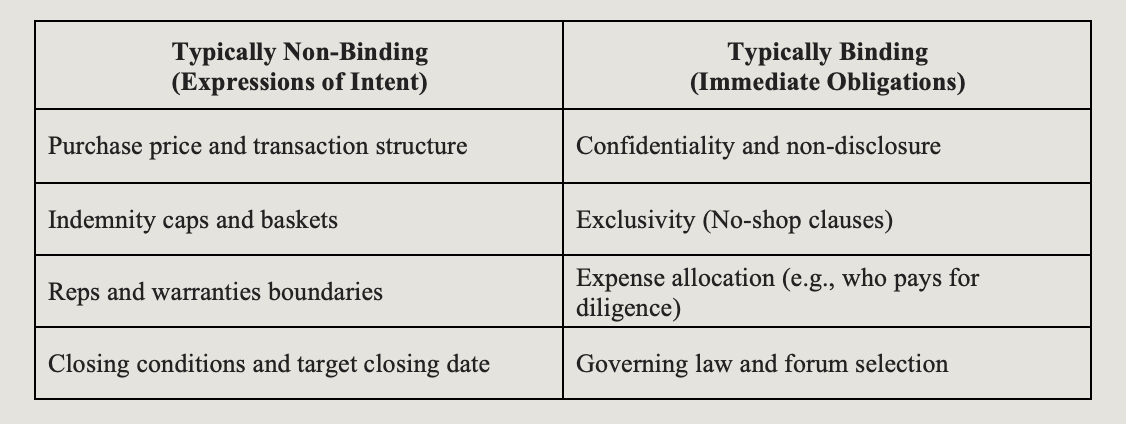
Most well-drafted LOIs and term sheets are hybrid documents. They explicitly state that the parties are not yet bound to close the primary transaction. Provisions describing the structure, price, and terms of the ultimate transaction are typically non-binding in preliminary agreements because those terms are understood to be subject to further negotiation and due diligence. However, certain provisions, such as confidentiality, exclusivity, and expense allocation, are typically drafted as immediately binding because they govern the parties' conduct during negotiations rather than the ultimate transaction itself. Texas courts recognize that parties may intend to bind themselves to certain pre-closing obligations while leaving the final transaction terms open for future negotiation.
The division generally looks like this:
The Texas Pitfalls: Definiteness and “Agreements to Agree”
Texas case law shows that relying on loose labels instead of precise drafting is a massive risk. Texas law adheres to strict rules regarding preliminary agreements that every business owner should know:
The “Agreement to Agree” Rule: Under Texas law, if an essential or material term is left too indefinite or open for future negotiation, the provision is deemed an unenforceable “agreement to agree.” To be legally binding, an LOI or term sheet must be sufficiently definite as to all essential terms so that a court can understand what the parties were required to do. What constitutes a “material” or “essential” term depends on the specific transaction and what the parties would reasonably regard as vitally important elements of their bargain. If a document leaves these critical details open for future adjustments that never actually occur, the transaction remains unenforceable.
The “Good Faith” Trap: Texas law does not automatically imply a duty to negotiate a final deal in good faith from the existence of a preliminary agreement alone. If parties wish to create an enforceable obligation to negotiate in good faith, they must expressly include such language in the LOI or term sheet and clearly designate it as a binding provision. However, parties should use good-faith negotiation clauses cautiously, as Texas courts may enforce them as independent contractual obligations separate from the ultimate transaction.
Written Conditions Prevail Over Future Conduct: Texas courts have consistently held that clearly written conditions precedent (e.g., stating that the parties do not intend to be bound until boards approve and definitive contracts are signed) can protect companies against future conduct that could unintentionally create a binding contract. Without such explicit conditions, actions taken after signing the LOI or term sheet, including emails, press releases, or partial performance, may be used as evidence that the parties waived the non-binding label of the preliminary agreements and instead formed a contract through their actions.
LOIs, Term Sheets, and the Statute of Frauds
Under the Texas Business and Commerce Code, certain agreements must be in writing and signed to be enforceable. This rule is commonly referred to as the “Statute of Frauds” and includes real estate sales and any agreement that cannot be fully performed within one year from the date it is made. For Texas businesses, the Statute of Frauds impacts LOIs and term sheets in the following critical ways:
No Oral Modifications: If your underlying deal falls under the Statute of Frauds (such as some corporate asset sales or a real estate transaction), you cannot orally amend the LOI or agree to new deal points over the phone. Any changes or extensions to deadlines must be in writing and signed to be recognized by a Texas court.
Be Cautious of Inadvertent Email Signatures: Emails can have the same legal effect as written records and handwritten signatures under the Texas Uniform Electronic Transactions Act (UETA). Because of this, an executive's email sending an updated term sheet and stating that the parties agree to these terms may constitute a binding electronic signature, potentially creating enforceable obligations before formal documents are signed, even if the parties intended the LOI or term sheet to be non-binding.
The Real Estate Description Trap: Real estate LOIs can be especially vulnerable. Under Texas law, a property description must be definite enough to identify the property with reasonable certainty. If a preliminary agreement uses an imprecise or incomplete description, a court may decline to enforce the agreement, which can also jeopardize related binding provisions (such as confidentiality or exclusivity clauses) if they are not clearly drafted as separate, independent obligations that survive the failure of the underlying transaction.
The “One-Year Rule” for Long-Term Provisions: If your term sheet or LOI outlines a two-year non-compete clause, a multi-year joint venture structure, or a 14-month exclusivity window, these provisions cannot be performed within a year. Therefore, they strictly require a formal, signed writing to be enforceable.
Practical Guidance for Texas Businesses
Do not assume an LOI or term sheet is harmless boilerplate language. To protect your business, your preliminary agreements must be properly structured:
Explicitly Segregate the Clauses: Use clear, distinct headers separating the “Binding Provisions” (like confidentiality and exclusivity) from the “Non-Binding Provisions” (like price and deal structure).
Avoid Loose Language That Suggests a Present Commitment to Close: Do not use language that sounds like you are making a final deal today. Avoid phrases like “The parties agree to buy…” or “Buyer will purchase…” in non-binding sections. Instead, use conditional, future-focused language: “The parties intend to propose…” or “The definitive agreement would contemplate that…”
Utilize Express Conditions Precedent: State clearly that no contract for the transaction exists—and no party has a duty to close—unless and until a final, definitive agreement is executed and delivered, and formal Board of Directors or Member approval is obtained. Notably, in Texas, the phrase “subject to legal documentation” is ambiguous and should be avoided, as it could refer to a condition precedent to contract formation, or it could merely reference a future memorial of an already-enforceable agreement.
Set a Hard Drop-Dead Date: Ensure your binding exclusivity (“no-shop”) and negotiation windows have a firm expiration date and time so you aren't stuck in legal limbo if the deal stalls.
Add Non-Solicitation Protections: If you are sharing operational secrets or employee data during due diligence, ensure a binding employee and customer non-solicitation clause protects your business if negotiations fail.
Protect Against “Conduct Creep” and Control Post-Signing Conduct: Include a clause stating that subsequent conduct (e.g., emails, texts, or partial performance) cannot waive the non-binding status of the deal or create an accidental contract. While such clauses provide important protection, they are not absolute, as Texas courts may still examine the parties’ conduct and surrounding circumstances to determine whether the parties actually intended to be bound, particularly where the conduct is inconsistent with the non-binding label. As a result, it is important to remind your deal team to act consistently with the non-binding nature of the document and avoid language or conduct that could be construed as acceptance or a commitment to close.
For Texas businesses, the question is not whether a document is called a letter of intent or a term sheet, but whether it clearly states what is binding, what is not, and which material terms remain open. A clearly worded preliminary agreement can drastically reduce the risk of a later dispute, protect your operations, and help keep the transaction on track.
Ready to get started? Click here to schedule a consultation with Kalaria Law today to ensure your LOI or term sheet creates a secure blueprint for a successful transaction.
Disclaimer: This article is for general informational purposes only and does not constitute formal legal advice.
