
Tax Attorney vs. CPA: What’s the Difference and Which Do You Need?
Whether you’re launching a company, structuring a complex transaction, or planning for the sale of your business, all significant business decisions carry important financial and tax considerations. When faced with a tax issue, many business owners struggle to answer a foundational question: Should I call a tax attorney or a Certified Public Accountant (CPA)?
While both professionals possess deep expertise in taxation, their focus and skill sets are fundamentally distinct. Understanding these distinctions ensures you engage the right advisor at the right time—or leverage both to build an airtight tax strategy.
At a Glance: Key Differences
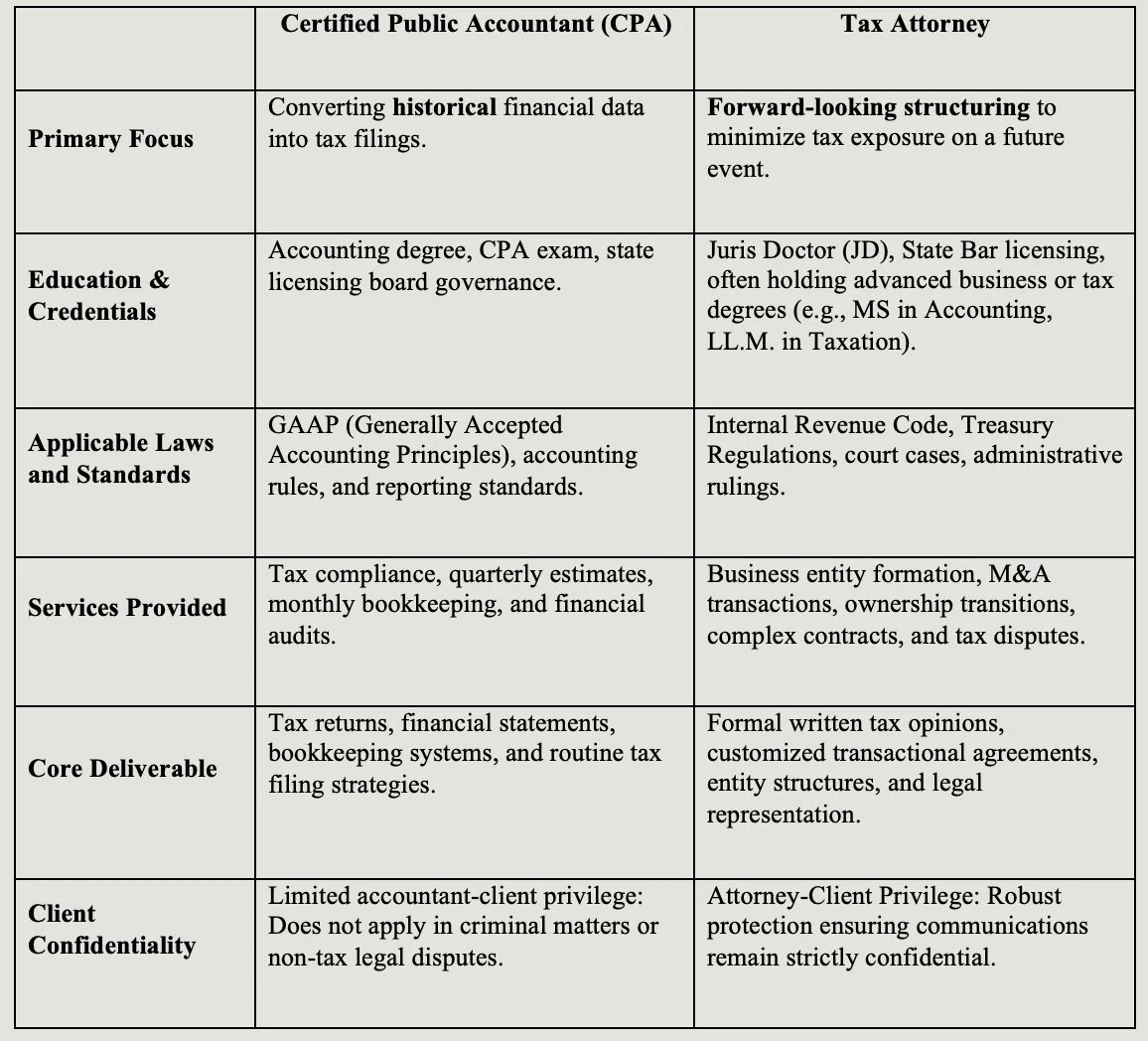
What Does a CPA Do?
A CPA is an accounting professional licensed by a state board to oversee accounting processes, ensure regulatory reporting compliance, and optimize financial records.
CPAs typically handle:
Tax Preparation & Compliance: Preparing and filing annual federal, state, and local tax returns (Form 1040, Form 1120, Form 1065, etc.).
Financial Accounting: Auditing financial records, creating balance sheets, and maintaining general ledgers.
Accounting Systems & Operations: Designing bookkeeping systems, managing cash flow analysis, and overseeing payroll systems.
Routine Tax Planning: Identifying standard deductions, tax credits, and depreciation schedules during annual tax filings.
A CPA is your numbers professional. If your question is “How much do I owe and how do I file it correctly?”, a CPA is usually who you want.
What Does a Tax Attorney Do?
A tax attorney is a licensed legal professional specializing in tax law and statutory interpretation. Tax attorneys analyze how local, state, and federal tax laws impact transactions, business operations, and wealth preservation.
Tax attorneys typically handle:
Entity Structuring & Governance: Creating multi-tiered entity structures built for long-term tax efficiency and liability protection and evaluating availability of tax elections or benefits (e.g., Qualified Small Business Stock (QSBS)).
M&A Transaction Structuring: Designing tax-efficient structures for transactions (e.g., asset vs. equity sales, rollover equity).
Written Tax Opinions & Analysis: Delivering formal written tax advice, memorandum, and legal opinions analyzing complex or ambiguous areas of tax law.
Estate & Succession Planning: Structuring trusts and business succession plans to minimize estate and gift tax exposure.
Controversy & Legal Representation: Representing clients in complex IRS disputes, tax litigation, or state tax authority audits.
A tax attorney is your legal professional. If your question is “What’s the best way to structure this deal so I don’t get hit with unnecessary tax?”, you’ll want to discuss with a tax attorney.
Where the Overlap is (and Why Clients Get Confused)
Both professionals can do tax planning. Both can represent you before the IRS. Both understand the tax code deeply. The difference is usually about the nature of the problem and the kind of risk involved.
A CPA handles routine annual compliance with the IRS and state tax authorities. However, the moment a matter involves significant legal interpretation, litigation risk, or a deal where structure drives the tax outcome, an attorney's involvement becomes valuable.
A question we get a lot is, “Can you do my taxes”?
Some tax attorneys do prepare returns, but most tax attorneys do not. Our firm's tax practice focuses on the legal side: deal structuring, tax memos, legal opinions, and the tax consequences of transactions. We are not a return-preparation shop, and for routine filing and bookkeeping, a CPA is genuinely the better and more cost-effective fit.
We do work with CPAs all the time. On a typical business sale or acquisition, the attorney structures the deal and handles preparing and negotiating the legal documents, while the CPA handles the financials and the eventual filings. The two roles complement each other rather than compete.
A Quick “Who Do I Call" Guide
Reach out to a CPA when you need to:
File a personal or business tax return
Keep your books, payroll, and cash flow in order
Obtain audited financial statements for lenders or investors
Seek guidance on routine tax deductions and annual filing strategies
Get through a standard IRS audit
Reach out to a tax attorney when you need to:
Form or restructure a company
Structure a business sale, acquisition, or major real estate transaction
Get a legal opinion or tax memo on a specific position
Navigate complex tax rules
Develop an estate plan or business succession plan
Resolve a serious tax dispute or face potential litigation
Often, the most effective business strategies do not treat CPAs and tax attorneys as mutually exclusive alternatives; rather, they rely on both working together.
If you’re not sure whether your matter is one we can help with, just ask. We're happy to point you in the right direction, even if the answer is “You actually want a CPA for this.”
Ready to start? Click here to schedule a consultation with Kalaria Law today to ensure your tax strategy is integrated from day one.
Disclaimer: This article is for general informational purposes only and does not constitute formal legal advice.
