
A Closer Look at Physician Employment Agreements in Texas: Five Terms Every Doctor Should Read Twice
Most physicians review an employment agreement for salary, signing bonus, and start date, then skim the rest. However, the fine print is usually where the real risk lives.
Here are key five provisions worth slowing down for before you sign to ensure your autonomy, future career mobility, and financial interests are protected.
1. Restrictive Covenants & Texas Non-Compete Requirements
Non-compete clauses are among the most heavily litigated aspects of physician employment. While some states ban physician non-competes entirely, Texas allows them under Texas Business and Commerce Code Section 15.50. This statute was amended in September 2025, resulting in more stringent requirements for a non-compete to be enforceable.
When reviewing a non-compete in Texas, ensure it complies with the following mandatory safeguards:
Geographic and Duration Limits: Non-compete covenants must be capped at a maximum geographic radius of 5 miles from your primary practice location and cannot exceed 1 year in duration.
If you are expected to rotate across multiple clinics or hospital sites, specify these locations in writing. Crucially, confirm which facility is designated as your "primary practice location," as this anchors your 5-mile non-compete radius.
Buyout Provision: Agreements must provide a reasonable buyout option, capped by law at no more than your total annual salary and wages at the time of separation.
Patient Access Rights: Texas law mandates that you retain the right to access a list of patients you treated within the prior 12 months, as well as access to medical records upon patient consent, for a reasonable fee.
Continuity of Care for Acute Illness: A non-compete cannot enforce restrictions that interfere with your right to continue treating specific patients experiencing an acute illness.
Involuntary Termination Safeguards: Your non-compete should explicitly state that restrictive covenants become void if your employment is terminated involuntarily without "good cause."
These requirements do not apply to non-competes tied purely to administrative roles, like a medical director agreement, which are instead judged under a general reasonableness standard.
2. Compensation Structures & Incentive Models
Physician compensation models vary widely depending on whether you are joining a private practice, an academic medical center, or a large health system.
Base Salary vs. Productivity Models:
Contracts typically offer either a guaranteed base salary, a pure productivity model (such as Work Relative Value Units (wRVUs) or collections), or a hybrid blend. If your pay relies on wRVU targets, confirm that the contract specifies how wRVUs are calculated, what happens during a slow ramp-up period or an extended leave, and how administrative or non-clinical time is factored in.
Bonuses and Clawback Schedules:
Signing bonuses, retention bonuses, and relocation stipends are standard tools for attracting talent. However, pay close attention to the fine print regarding clawback schedules. If you leave prior to a specified timeframe (often 2 to 3 years), you may be required to repay a prorated portion—or even 100%—of those upfront funds.
Regulatory Considerations:
Texas enforces a strict Corporate Practice of Medicine (CPOM) doctrine, which generally prohibits non-physician entities or corporations from practicing medicine or employing physicians directly. Understanding how your employer is structured (e.g., via a Friendly Physician Model or a regional hospital authority) helps ensure your compensation model remains compliant and your clinical decision-making stays independent.
Compensation formulas in physician contracts also have to stay within fair market value and cannot be structured in a way that ties pay to the volume or value of referrals, since that can create Stark Law and Anti-Kickback Statute exposure for the practice, and potentially for you. A formula that looks generous on paper can also be a compliance problem if it's not properly benchmarked.
3. Professional Liability Insurance & Malpractice Coverage
Malpractice coverage is non-negotiable, but the type of policy your employer provides dictates your financial risk when you eventually leave the practice.
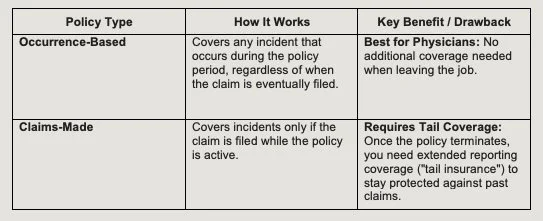
Tail coverage can cost anywhere from 1.5 to 3 times your annual malpractice premium—often tens of thousands of dollars.
Negotiate who pays for tail coverage upon contract termination. Common middle-ground solutions include:
Vesting Schedules: The employer covers 20% to 25% of tail costs for each year of completed service, paying 100% after 4 or 5 years.
Termination Triggers: The employer pays for tail coverage if they terminate you without cause. You pay if you resign or are terminated for cause.
4. Termination Provisions & Post-Employment Rights
How a contract ends is just as important as how it begins. Pay close attention to notice requirements and termination triggers.
Termination Without Cause: Either party should be able to terminate the agreement without specifying a reason by providing written notice (typically 60 to 90 days). This notice period gives you adequate time to secure new employment or transition care.
Termination For Cause: Employers can terminate agreements immediately for severe issues, such as loss of medical license, felony conviction, or exclusion from Medicare/Medicaid.
Right to Cure: For minor administrative or performance breaches, negotiate a 30-day "right to cure" period. This allows you to resolve issues before the employer can trigger a "for cause" termination.
5. Change of Control & Sale of Employer Provisions
Because of the frequency of healthcare transactions, like private equity buyouts, hospital system mergers, and practice acquisitions, understanding what happens to your role if your employer changes hands is worth understanding upfront, rather than discovering it mid-transaction.
Protect Yourself Before You Sign
A physician employment agreement governs your compensation, ability to practice in the future, and allocation of malpractice risk all in one document. Taking the time to consider these provisions before you sign can provide long-term career satisfaction, financial security, and peace of mind.
Ready to start? Click here to schedule a consultation with Kalaria Law today to ensure that your employment agreement has your best interests in mind.
Disclaimer: This article is for general informational purposes only and does not constitute formal legal advice.
