
Contract Assignment vs. Change of Control: What Business Owners Need to Know Before a Sale
When preparing your business for a sale, most of your focus naturally goes toward valuation, deal terms, and potential buyers. However, one overlooked detail during M&A due diligence can cause delays or even reduce deal value: transfer restrictions buried in your routine commercial agreements.
Whether structured as an anti-assignment restriction or a Change-of-Control (CoC) provision, these legal terms determine whether your company can transfer key contracts to a buyer without third-party permission.
Assignment vs. Change of Control: What’s the Difference?
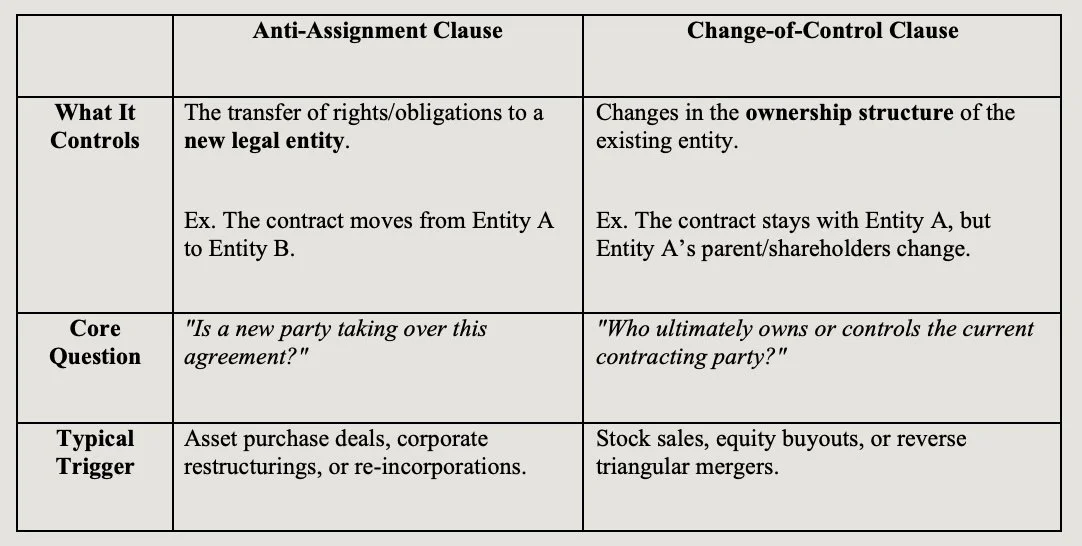
A common point of confusion for business owners is the distinction between an anti-assignment provision and a change-of-control provision. While both regulate contract transfers, they operate under entirely different legal mechanisms:
How Deal Structure Impacts Contract Requirements
The operational burden on the seller shifts dramatically depending on whether your acquisition is structured as an asset purchase or an equity purchase:
Asset Sale
In an asset deal, the buyer forms or uses a separate legal entity to acquire designated assets and business operations.
Anti-Assignment Provisions Apply: Because contracts are physically transferred from the seller entity to the buyer entity, standard anti-assignment rules are triggered across the board.
Consent Burden: Every commercial contract, real estate lease, or software license being transferred must be reviewed for assignment consent requirements, even if the contract contains no Change-of-Control language.
Equity / Stock Sale
In a stock or equity deal, the target company remains intact—only the ownership of the company changes hands.
Anti-Assignment Provisions Stay Dormant: Because the legal contracting entity remains identical before and after closing, standard anti-assignment clauses are usually not triggered.
Change-of-Control Provisions Triggered: Contracts with explicit CoC language or "deemed assignment" definitions will trigger, requiring notice or consent prior to closing.
How Transfer Restrictions Are Drafted in Commercial Agreements
Contractual transfer restrictions range from simple notification rules to strict approval requirements. Recognizing these variations early helps determine how much leverage a counterparty holds during a deal:
Notice-Only Obligations (Least Strict): Require informing the counterparty of a contract transfer or ownership shift within a set timeframe (e.g., 30 days post-closing), but do not grant the counterparty any approval or cancellation rights.
Standard Anti-Assignment Rules: Prohibit physically moving contract rights or obligations to a new legal entity without prior written consent, but remain completely silent on equity ownership shifts (dormant during stock deals).
Explicit Change-of-Control Consent Requirements: Mandate prior written consent before any change in majority equity ownership, voting rights, or operational control can occur, regardless of whether the legal entity changes.
"Deemed Assignment" Provisions: Explicitly define any equity sale, merger, or corporate restructuring as an assignment under the contract, closing the loophole between anti-assignment language and stock sales.
Termination & Acceleration Rights (Most Strict): Grant the counterparty the right to immediately terminate the agreement, withhold ongoing performance, or accelerate financial liabilities (demanding full immediate repayment in loans/leases) if an unauthorized transfer or ownership change occurs.
The Consequences of Overlooking Transfer Consents
Failing to secure required consents before closing creates severe friction:
Closing Conditions: Buyers frequently condition the deal closing on obtaining consents for 100% of "Material Contracts."
Indemnification Exposure: Unconsented transfers can trigger default clauses, exposing sellers to post-closing indemnity claims or indemnity holdbacks.
Ransom Risk: Strategic vendors or key customers may demand revised pricing, fee waivers, or updated terms in exchange for signing consent forms.
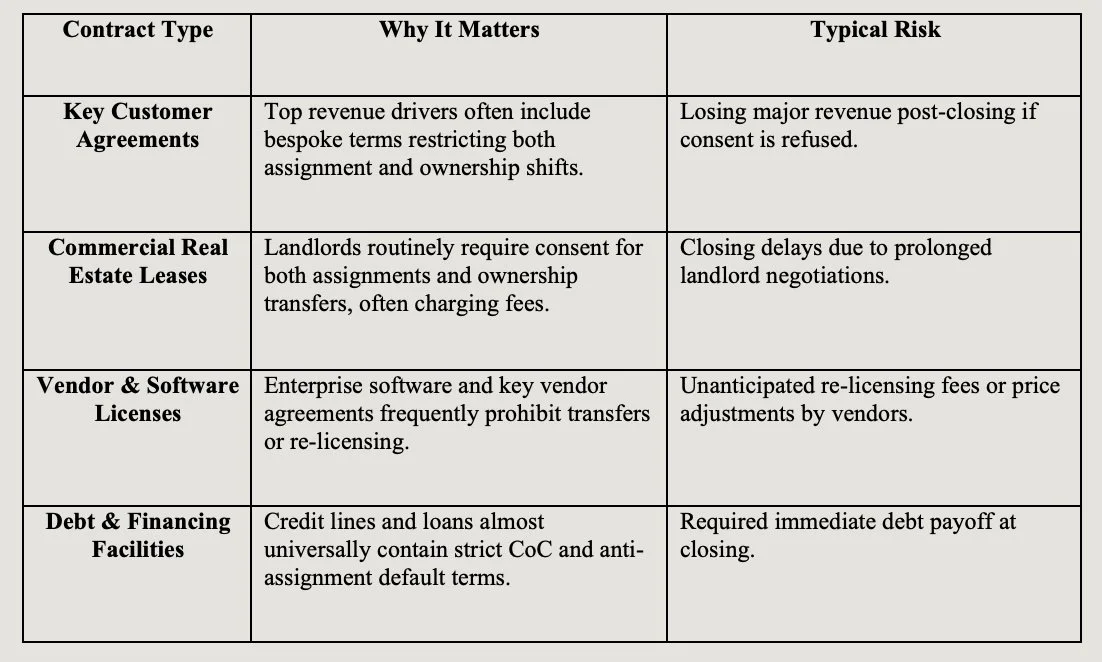
Key Contracts That Frequently Feature Assignment & CoC Restrictions
During a deal’s due diligence process (or even better, when preparing for a sale), you should prioritize auditing the following high-impact agreements:
4 Strategies for Managing Contract Transfers on the Sell-Side
To prevent assignment and Change-of-Control provisions from disrupting your transaction, consider these proactive steps:
Conduct an Early Contract Audit: Review all active commercial agreements, leases, and licenses 6 to 12 months before going to market. Identify whether each agreement requires prior consent or simple post-closing notification.
Categorize Risk Levels: Divide required consents into "Deal-Breakers" (key customers/landlords) versus "Minor Operational Contracts." Focus your initial deal preparation on high-priority contracts.
Address Consents in the Letter of Intent (LOI): Ensure the LOI clearly states which contract consents are formal closing conditions and which can be handled post-closing or waived.
Time Outreach Carefully: Seeking consent too early can breach deal confidentiality or alarm customers before the transaction is finalized. Coordinate with your legal team to approach counterparties only after definitive purchase agreements are signed and the deal structure is settled.
Understanding how both contract assignment and Change-of-Control provisions function allows business owners to structure deals effectively and navigate due diligence with confidence. By auditing your commercial contracts early and managing consent outreach strategically, you protect deal value and ensure a smooth path to closing.
Ready to start? Click here to schedule a consultation with Kalaria Law today if you’re preparing for a sale and want to understand the assignment and change-of-control provisions embedded in your company’s key contracts.
Disclaimer: This article is for general informational purposes only and does not constitute formal legal advice.
