
Are Your Employees and Contractors Unknowingly Owning Your IP?
When founders and business leaders evaluate what is driving the value of their company, intellectual property (IP) (think proprietary code, brand assets, product blueprints, technical documentation, and customer databases) usually sits near the top. Yet, one of the most common (and expensive) red flags uncovered during due diligence in a sale or a financing round is an incomplete chain of title— The company doesn’t actually own the IP it relies so heavily on.
Many executives operate under the assumption that paying a salary or an invoice automatically transfers ownership to the business. However, this is not the case under U.S. intellectual property laws. Without the right agreements in place, your employees and independent contractors might legally own your IP, often without either side even realizing it.
The Default Legal Rule: Why Paying Isn’t Owning
To understand the risk, you have to look at the existing framework of U.S. copyright and patent law:
Copyright Law: Under the Copyright Act, the initial author or creator of a work is the default legal owner of the copyright from the moment the work is fixed in a tangible medium.
Patent Law: An invention belongs initially to the individual inventor(s) who conceived it, not to the company paying their bills.
Unless a specific legal exception applies or a valid written assignment transfers those rights, the individual who created the asset retains ownership.
Legal Pitfalls of IP Created by Employees vs. Independent Contractors
The rules governing IP ownership differ drastically depending on whether the creator is a W-2 employee or an independent contractor.
1. Contractors: The “Work-Made-for-Hire” Myth
For external contractors, design agencies, and freelance developers, companies frequently put a basic "work-made-for-hire" clause in a contractor agreement and assume the business is fully protected.
Under the Copyright Act, however, a contractor's work only qualifies as a work made for hire if:
It is specially ordered or commissioned, and
It falls strictly into one of nine specified categories (such as a contribution to a collective work, part of a motion picture, a translation, or an instructional text).
Many high-value business assets, such as custom software code, mobile applications, standalone design assets, and marketing materials, frequently fail to fit neatly into these nine categories.
The Result: If a contractor agreement relies solely on "work-made-for-hire" language without an explicit, present-tense assignment clause, the contractor remains the legal owner of the copyright. Paying the invoice merely grants the business an implied, non-exclusive license to use the work, and that license may be difficult to transfer or enforce in an acquisition.
2. Employees: Scope of Employment Disputes
For bona fide W-2 employees, the Copyright Act provides that works created "within the scope of employment" generally belong to the employer as a matter of law. While this creates a broader safety net than contractors receive, significant blind spots remain:
Off-Hours & Personal Devices: If an engineer writes code over the weekend, works from a personal laptop, or solves a technical challenge outside regular hours, disputes often arise over whether the creation was truly within the “scope of employment.”
Patents and Inventions: Unlike copyrights, there is no automatic “work-made-for-hire” doctrine for patents. While an employer may obtain a limited “shop right” (i.e., a non-exclusive, non-transferable license to use the invention internally), the employee retains full ownership of the patent rights unless a written assignment is executed.
What Happens When Ownership Is Unclear?
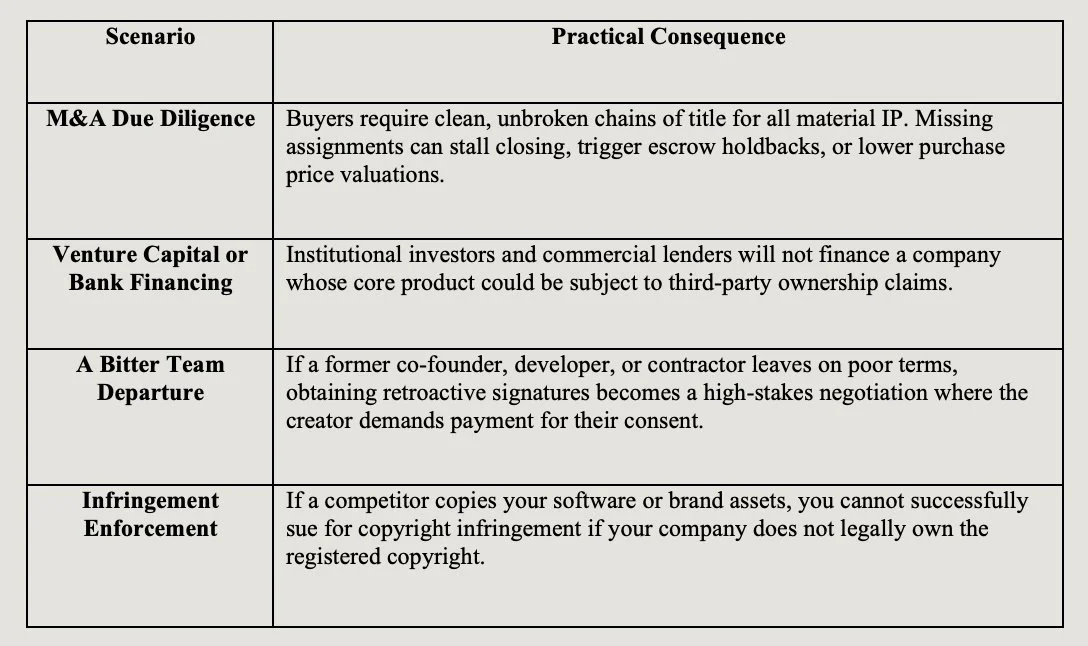
Failing to secure proper IP ownership agreements rarely causes friction during the ordinary course of daily business. Instead, the problem erupts when stakes are highest:
4 Essential Protections Every Business Should Implement
Securing your company’s intellectual property requires proactive legal safeguards before critical assets are developed.
1. Require Comprehensive PIIAs for All Employees
Every employee, regardless of seniority, should sign a Proprietary Information and Inventions Agreement (PIIA) (sometimes referred to as a Confidentiality and Inventions Assignment Agreement) on or before their first day.
A well-drafted PIIA should include:
Broad definitions covering all forms of IP (copyrights, patents, trade secrets, trademarks).
Clear carve-outs for pre-existing inventions that the employee created prior to joining.
Strict confidentiality and return-of-materials provisions.
2. Use Present-Tense Assignment Language
The specific phrasing used in assignment clauses carries immense legal weight.
The Flawed Approach: Language stating that the creator “agrees to assign” or “will assign” their inventions is merely a promise to assign in the future. Courts have held that this phrasing does not automatically transfer title when the IP is created.
The Enforceable Standard: The agreement must use present-tense transfer language: “The creator hereby assigns and transfers all right, title, and interest…” This ensures an immediate, automatic transfer of rights the moment the asset comes into existence.
3. Couple Contractor Agreements with a Power of Attorney
In independent contractor agreements, do not rely on standard “work-for-hire” provisions alone. Always include a dual mechanism:
State that the work is a work made for hire to the fullest extent permitted by law.
Include an explicit backup provision stating that if the work does not legally qualify, the contractor hereby irrevocably assigns all rights, title, and interest to the company.
Additionally, include a limited power of attorney clause allowing the company to execute patent applications or copyright filings on the contractor's behalf if they become unavailable or uncooperative down the road.
4. Audit Your Historical Chain of Title
If your business has been operating for several years, conduct an internal IP audit:
Identify key software, source code, logos, and proprietary workflows.
Trace who built each asset (early founders, current staff, former contractors, overseas development shops).
Verify whether valid, signed assignment agreements exist for every contributor.
Execute retroactive assignment and release agreements while relationships remain amicable, rather than waiting for an M&A transaction to expose the gap.
Securing Your Core Value
Intellectual property is most valuable if you can prove you own it. Relying on handshakes, standard vendor invoices, or assumptions about employee relationships leaves your core enterprise value vulnerable to costly disputes.
By implementing standardized PIIAs, bulletproof contractor assignments, and regular corporate hygiene audits, business owners can protect their balance sheet, safeguard their valuation, and ensure that every asset they pay to create stays firmly in the company’s hands.
Ready to start? Click here to schedule a consultation with Kalaria Law today if you need help reviewing your company’s assignment documents to ensure a clean chain of title.
Disclaimer: This article is for general informational purposes only and does not constitute formal legal advice.
